Dreamers = detachment from the world.tenderness and fragility.receptiveness to beauty.weak-willedness and listlessness.luxuriant imagination and dereism.usually inflated self-concept.-----DSM = A mix of schizoid, narcissistic, and histrionic features. Both schizotypal and avoidant features can also be present.-----Milton= schizotypal.
-wikipedia
Showing posts with label HPDBehavior. Show all posts
Showing posts with label HPDBehavior. Show all posts
Friday, May 13, 2016
Subtypes (Pyotry) - Hysterical personalities
Hysterical personalities = attention seeking behavior combined with fear of indifference, an ardent desire to be not like all the others.appearance consciousness.the absence of objective truth in relation both to themselves and those around them.histrionics, theatricalism, deceitfulness weak-willedness combined with superficial, capricious, and unstable emotions.-----DSM = Histrionic personality disorder. Can be combined with some dependent and negativistic features.-----Milton = Theatrical, appeasing or tempestuous histrionic personality
- wikipedia
- wikipedia
Subtypes (Pyotry) - Pathological liars
Pathological liars = prominent social defects, which includes extreme slovenliness.attention seeking and manipulative behavior.appearance consciousness.excessively excitable, immature, and rich imagination.high eloquence.involvement in fraud, charlatanism, crooked gambling.-----DSM = Histrionic personality disorder with some antisocial features.Narcissistic personality disorder with some antisocial features.Borderline personality disorder with some antisocial features.-----Milton = Disingenous histrionic personality.Unprincipled narcissistic personality.Impulsive borderline personality"
- wikipedia
- wikipedia
Subtype - Constitutionally excitable (Pyotry's subtype) @ Wikipedia
Constitutionally excitable = constantly elevated mood. vigor and enterprise. flexibility and multifacetedness. superficiality of interests. overtalkativeness.excessive demand for amusement
-----DSM = Histrionic personality disorder with some narcissistic features, Hypomania.
-----Milton = Vivacious histrionic personality.
-Wikipedia
-----DSM = Histrionic personality disorder with some narcissistic features, Hypomania.
-----Milton = Vivacious histrionic personality.
-Wikipedia
Saturday, May 7, 2016
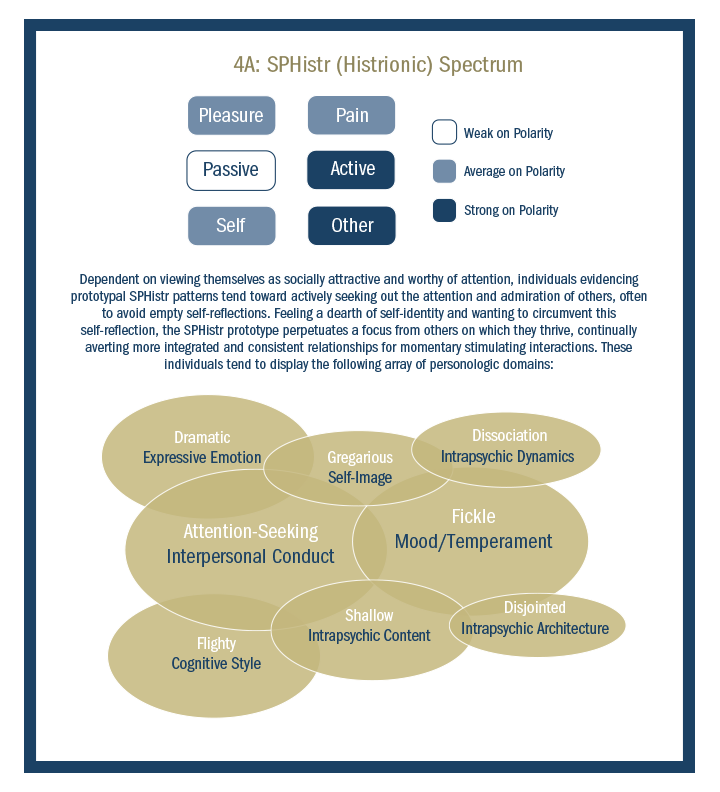
Subtypes - Tempestuous (Including negativistic features) @ Wikipedia
"Impulsive, out of control; moody complaints, sulking; precipitous emotion, stormy, impassioned, easily wrought-up, periodically inflamed, turbulent."
@ Wikipedia
@ Wikipedia
Subtypes - Vivacious (Including hypomania and narcissistic features) @ Wikipedia
"The seductiveness of the histrionic mixed with the energy typical of hypomania. Some narcissistic features can also be present
Vigorous, charming, bubbly, brisk, spirited, flippant, impulsive; seeks momentary cheerfulness and playful adventures; animated, energetic, ebullient."
@ Wikipedia
Vigorous, charming, bubbly, brisk, spirited, flippant, impulsive; seeks momentary cheerfulness and playful adventures; animated, energetic, ebullient."
@ Wikipedia
Subtypes - Appeasing (Including dependent and compulsive features) @ Wikipedia
"Seeks to placate, mend, patch up, smooth over troubles; knack for settling differences, moderating tempers by yielding, compromising, conceding; sacrifices self for commendation; fruitlessly placates the unplacatable."
@ Wikipedia
@ Wikipedia
Subtypes - Disingenuous (Including antisocial features) @ Wikipedia
"Underhanded, double-dealing, scheming, contriving, plotting, crafty, false-hearted; egocentric, insincere, deceitful, calculating, guileful."
@ Wikipedia
@ Wikipedia
Subtypes - Theatrical (Variant of “pure” pattern) @ WIkipedia
"Affected, mannered, put-on; postures are striking, eyecatching, graphic; markets self-appearance; is synthesized, stagy; simulates desirable/dramatic poses."
@ Wikipedia
@ Wikipedia
Subtypes - Infantile (Including borderline features) @ Wikipedia
"Labile, high-strung, volatile emotions; childlike hysteria and nascent pouting; demanding, overwrought; fastens and clutches to another; is overly attached, hangs on, stays fused to and clinging."
@ Wikipedia
@ Wikipedia
Sunday, April 24, 2016
Saturday, April 23, 2016
Practice Wisdom: Differentiating Borderline and Histrionic Personalities
"My supervisor suggests that these different driving forces manifest in the intent behind the client's "dramatic, emotional, or erratic" behavior. Specifically, it is more characteristically erratic in BPD - the emotionality is not typically planned or intended, but the result of the client feeling like s/he is out of control, or even dissolving. In contrast, the behavior seems more instrumental (i.e., goal directed) in HPD - it is in service of gratifying the need for attention, with more calculation as to the effect the behavior will have on others. Thus, clients with BPD may be much more likely to experience unintended effects of their behavior, but still be unable to choose more adaptive behavior. My supervisors suspected that our client had HPD because she seemed more in control and calculating in her behavior than one would expect from BPD."
See entire article @ Practice Wisdom
See entire article @ Practice Wisdom
HPD vs. BPD by user @ Psych Forums
Stealing not intended. Just do not want this great information to get lost or deleted
"Talking HPD women and BPD women...IMO
Many HPDs have similar overlaps with BPD's:
-HPDs are also looking for a hero and savior (often casting you using in white knight or prince imagery)
-HPDs can also act like they are vulnerable, and often seem much younger than they are.
-HPDs can also turn into haters, splitting you, in which you go from white knight and savior to a betraying dark pariah.
-Many HPD's also have periodic windows of both dissociation and empathy, although as a general rule BPD's dissociate more intensely than HPDs and maybe because BPD's are afraid of abandonment, they seem more empathetic than HPD's.
Possible differences:
-HPD's are often very attractive; therefore they exude more social power and confidence than BPD's.
-A significant percentage of HPDs experience sexual satisfaction problems, and despite their seductive behavior they have little interest in sex; BPDs more readily become addicted to sex (or drugs, alcohol, etc,), perhaps as a way to ameliorate the BPD aversive tension they live with.
-BPD's are more paranoid when it comes to others; HPDs gullibly, even carelessly approach others (incl. AsPDs or other exploitative people ) in search of supply: attention and validation.
-From her side, the HPD relationship has a lighter, more carefree feel; you don't feel so that one-on-one intensity as in a BPD relationship.
-HPD is more organized, to the extent that besides a main boyfriend, many run a fan club with other guys that they are flirting with..."emotional cheating"... or in some limited cases, also having intimate affairs with. The main b/f and the members of the fan club are usually kept seperate by the HPD, and thus there is often a secretive air about all these goings on.
-In some HPD's the splitting also causes them to run two types of male relationships, either one right after the other, or in some cases at the same time, with these male types:
(a) older guys who are like father figures to the HPD
(b) younger 'bad boys,' who are often NPD or AsPD. or who have at least those some of those traits.
"Talking HPD women and BPD women...IMO
Many HPDs have similar overlaps with BPD's:
-HPDs are also looking for a hero and savior (often casting you using in white knight or prince imagery)
-HPDs can also act like they are vulnerable, and often seem much younger than they are.
-HPDs can also turn into haters, splitting you, in which you go from white knight and savior to a betraying dark pariah.
-Many HPD's also have periodic windows of both dissociation and empathy, although as a general rule BPD's dissociate more intensely than HPDs and maybe because BPD's are afraid of abandonment, they seem more empathetic than HPD's.
Possible differences:
-HPD's are often very attractive; therefore they exude more social power and confidence than BPD's.
-A significant percentage of HPDs experience sexual satisfaction problems, and despite their seductive behavior they have little interest in sex; BPDs more readily become addicted to sex (or drugs, alcohol, etc,), perhaps as a way to ameliorate the BPD aversive tension they live with.
-BPD's are more paranoid when it comes to others; HPDs gullibly, even carelessly approach others (incl. AsPDs or other exploitative people ) in search of supply: attention and validation.
-From her side, the HPD relationship has a lighter, more carefree feel; you don't feel so that one-on-one intensity as in a BPD relationship.
-HPD is more organized, to the extent that besides a main boyfriend, many run a fan club with other guys that they are flirting with..."emotional cheating"... or in some limited cases, also having intimate affairs with. The main b/f and the members of the fan club are usually kept seperate by the HPD, and thus there is often a secretive air about all these goings on.
-In some HPD's the splitting also causes them to run two types of male relationships, either one right after the other, or in some cases at the same time, with these male types:
(a) older guys who are like father figures to the HPD
(b) younger 'bad boys,' who are often NPD or AsPD. or who have at least those some of those traits.

Thursday, April 14, 2016
Histrionic personality disorder - causes, DSM, effects, therapy, adults, people, used, medication @ Mind Disorders(dot) com
"There is a lack of research on the causes of HPD. Even though the causes for the disorder are not definitively known, it is thought that HPD may be caused by biological, developmental, cognitive, and social factors.
NEUROCHEMICAL/PHYSIOLOGICAL CAUSES. Studies show that patients with HPD have highly responsive noradrenergic systems, the mechanisms surrounding the release of a neurotransmitter called norepinephrine. Neurotransmitters are chemicals that communicate impulses from one nerve cell to another in the brain , and these impulses dictate behavior. The tendency towards an excessively emotional reaction to rejection, common among patients with HPD, may be attributed to a malfunction in a group of neurotransmitters called catecholamines. (Norepinephrine belongs to this group of neurotransmitters.)
DEVELOPMENTAL CAUSES. Psychoanalytic theory, developed by Freud, outlines a series of psychosexual stages of development through which each individual passes. These stages determine an individual's later psychological development as an adult. Early psychoanalysts proposed that the genital phase, Freud's fifth or last stage of psychosexual development, is a determinant of HPD. Later psychoanalysts considered the oral phase, Freud's first stage of psychosexual development, to be a more important determinant of HPD. Most psychoanalysts agree that a traumatic childhood contributes towards the development of HPD. Some theorists suggest that the more severe forms of HPD derive from disapproval in the early mother-child relationship.
Another component of Freud's theory is the defense mechanism. Defense mechanisms are sets of systematic, unconscious methods that people develop to cope with conflict and to reduce anxiety. According to Freud's theory, all people use defense mechanisms, but different people use different types of defense mechanisms. Individuals with HPD differ in the severity of the maladaptive defense mechanisms they use. Patients with more severe cases of HPD may utilize the defense mechanisms of repression, denial , and dissociation.
BIOSOCIAL LEARNING CAUSES. A biosocial model in psychology asserts that social and biological factors contribute to the development of personality. Biosocial learning models of HPD suggest that individuals may acquire HPD from inconsistent interpersonal reinforcement offered by parents. Proponents of biosocial learning models indicate that individuals with HPD have learned to get what they want from others by drawing attention to themselves.
SOCIOCULTURAL CAUSES. Studies of specific cultures with high rates of HPD suggest social and cultural causes of HPD. For example, some researchers would expect to find this disorder more often among cultures that tend to value uninhibited displays of emotion.
PERSONAL VARIABLES. Researchers have found some connections between the age of individuals with HPD and the behavior displayed by these individuals. The symptoms of HPD are long-lasting; however, histrionic character traits that are exhibited may change with age. For example, research suggests that seductiveness may be employed more often by a young adult than by an older one. To impress others, older adults with HPD may shift their strategy from sexual seductiveness to a paternal or maternal seductiveness. Some histrionic symptoms such as attention-seeking, however, may become more apparent as an individual with HPD ages.
See more @ Mind Disorders(dot) com
NEUROCHEMICAL/PHYSIOLOGICAL CAUSES. Studies show that patients with HPD have highly responsive noradrenergic systems, the mechanisms surrounding the release of a neurotransmitter called norepinephrine. Neurotransmitters are chemicals that communicate impulses from one nerve cell to another in the brain , and these impulses dictate behavior. The tendency towards an excessively emotional reaction to rejection, common among patients with HPD, may be attributed to a malfunction in a group of neurotransmitters called catecholamines. (Norepinephrine belongs to this group of neurotransmitters.)
DEVELOPMENTAL CAUSES. Psychoanalytic theory, developed by Freud, outlines a series of psychosexual stages of development through which each individual passes. These stages determine an individual's later psychological development as an adult. Early psychoanalysts proposed that the genital phase, Freud's fifth or last stage of psychosexual development, is a determinant of HPD. Later psychoanalysts considered the oral phase, Freud's first stage of psychosexual development, to be a more important determinant of HPD. Most psychoanalysts agree that a traumatic childhood contributes towards the development of HPD. Some theorists suggest that the more severe forms of HPD derive from disapproval in the early mother-child relationship.
Another component of Freud's theory is the defense mechanism. Defense mechanisms are sets of systematic, unconscious methods that people develop to cope with conflict and to reduce anxiety. According to Freud's theory, all people use defense mechanisms, but different people use different types of defense mechanisms. Individuals with HPD differ in the severity of the maladaptive defense mechanisms they use. Patients with more severe cases of HPD may utilize the defense mechanisms of repression, denial , and dissociation.
BIOSOCIAL LEARNING CAUSES. A biosocial model in psychology asserts that social and biological factors contribute to the development of personality. Biosocial learning models of HPD suggest that individuals may acquire HPD from inconsistent interpersonal reinforcement offered by parents. Proponents of biosocial learning models indicate that individuals with HPD have learned to get what they want from others by drawing attention to themselves.
SOCIOCULTURAL CAUSES. Studies of specific cultures with high rates of HPD suggest social and cultural causes of HPD. For example, some researchers would expect to find this disorder more often among cultures that tend to value uninhibited displays of emotion.
PERSONAL VARIABLES. Researchers have found some connections between the age of individuals with HPD and the behavior displayed by these individuals. The symptoms of HPD are long-lasting; however, histrionic character traits that are exhibited may change with age. For example, research suggests that seductiveness may be employed more often by a young adult than by an older one. To impress others, older adults with HPD may shift their strategy from sexual seductiveness to a paternal or maternal seductiveness. Some histrionic symptoms such as attention-seeking, however, may become more apparent as an individual with HPD ages.
See more @ Mind Disorders(dot) com
Monday, December 28, 2015
Sunday, December 20, 2015
For Those Who Have Stayed By Erin Marshall @ TWLOHA
"I will be the first to admit that I am not easy to spend time with.It’s
exhausting and frustrating for me, and I imagine it is equally as
frustrating for you.I become irritable at the drop of a hat.I’m
controlling. It sucks having incredibly limited control of my mind and
the physical manifestations of my anxiety. To compensate, I crave
whatever control I can get. Staying on schedule and having a routine is
important because it provides me with something that I can count on.I
may present as clingy or dependent to some of you, requesting your
constant presence while going to the grocery store or the post office.
Please know this is because I trust you to help me tackle a task that
seems too daunting to do on my own. I apologize too often, convinced
that even the simplest inconveniences are my fault. Please don’t get
annoyed.I’m indecisive to the extreme. The fear of making the wrong
decision means that the odds of ever getting a straightforward answer
from me are likely zero. Please, if making me choose, at least limit it
to two choices.I believe that everyone who puts up with me secretly
hates me or finds me annoying. Please don’t take offense. I have the
tendency to push people away. I often passive aggressively vocalize and
push my frustrations with limitations onto those around me who are
living a ‘normal’ life. It’s merely an expression of jealousy of the
freedom you have. It has nothing to do with you. It is a poor coping
mechanism that I unfortunately use to conceal what I consider to be a
personal weakness. Please don’t take it personally.
See more @ TWLOHA
See more @ TWLOHA
Tuesday, September 1, 2015
Histrionic personality disorder @ Encyclopedia of mental disorders
"BIOSOCIAL LEARNING CAUSES. A biosocial model in psychology asserts that social and biological factors contribute to the development of personality. Biosocial learning models of HPD suggest that individuals may acquire HPD from inconsistent interpersonal reinforcement offered by parents. Proponents of biosocial learning models indicate that individuals with HPD have learned to get what they want from others by drawing attention to themselves.
SOCIOCULTURAL CAUSES. Studies of specific cultures with high rates of HPD suggest social and cultural causes of HPD. For example, some researchers would expect to find this disorder more often among cultures that tend to value uninhibited displays of emotion.
PERSONAL VARIABLES. Researchers have found some connections between the age of individuals with HPD and the behavior displayed by these individuals. The symptoms of HPD are long-lasting; however, histrionic character traits that are exhibited may change with age. For example, research suggests that seductiveness may be employed more often by a young adult than by an older one. To impress others, older adults with HPD may shift their strategy from sexual seductiveness to a paternal or maternal seductiveness. Some histrionic symptoms such as attention-seeking, however, may become more apparent as an individual with HPD ages."
More
SOCIOCULTURAL CAUSES. Studies of specific cultures with high rates of HPD suggest social and cultural causes of HPD. For example, some researchers would expect to find this disorder more often among cultures that tend to value uninhibited displays of emotion.
PERSONAL VARIABLES. Researchers have found some connections between the age of individuals with HPD and the behavior displayed by these individuals. The symptoms of HPD are long-lasting; however, histrionic character traits that are exhibited may change with age. For example, research suggests that seductiveness may be employed more often by a young adult than by an older one. To impress others, older adults with HPD may shift their strategy from sexual seductiveness to a paternal or maternal seductiveness. Some histrionic symptoms such as attention-seeking, however, may become more apparent as an individual with HPD ages."
More
Subscribe to:
Posts (Atom)